
App lock
Every row on the App lock screen: the master switch, what answers the lock (fingerprint, PIN, password or pattern), the list of screens and buttons you can lock, how long one check lasts, and what the lock does not protect.
The App lock puts a check in front of the settings screens and the delete buttons that you choose. The check is your fingerprint through the system prompt, or a PIN, a password or a pattern that you set in the app. You pick which screens and buttons, and which kind of check. Nothing is locked until you turn the feature on, and the list starts on a small set of sensible picks that you can change.
This page is the field reference. For what the keyboard stores and where, see Your data on device.
What the lock does and does not do
Section titled “What the lock does and does not do”Read this first. The rest of the page is easier to use once this is clear.
The lock hides screens inside the settings app. It does not encrypt anything, and it does not change how anything is stored. All of the following still read the same data:
- a backup file that you export from Backup & restore
- the Android backup, if you turned it on
- a computer with USB debugging enabled
- a rooted phone
- the keyboard itself, which keeps working exactly as before
What the lock stops is the case it is for. Somebody picks up your unlocked phone, opens the keyboard settings, and reads your word list or deletes your themes. That person now needs your fingerprint, or your PIN, password or pattern.
Turn the lock on
Section titled “Turn the lock on”To turn the lock on, do these steps:
- Open WM Keyboard Privacy App lock.
- Optional: under Unlock with, pick PIN, Password or Pattern and set it. Skip this to use your fingerprint.
- Set Use the app lock to on.
- Answer the check: your finger on the sensor, or the PIN, password or pattern you just set.
The switch moves only after the check passes. If the check fails, or if you cancel it, the switch goes back to off.
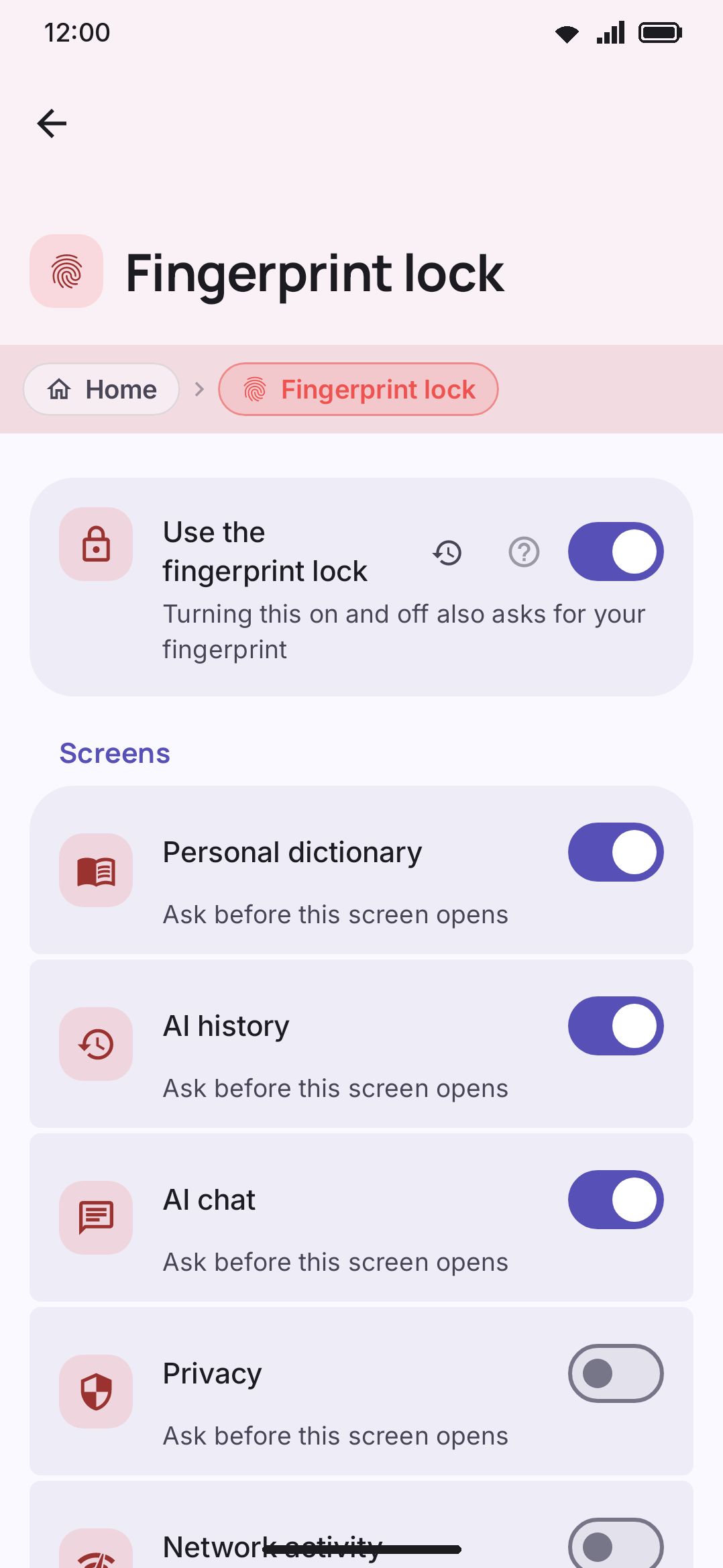
The first time you turn the lock on, the keyboard ticks a starter set for you: the personal dictionary, the AI history, the AI chats, the backup screen, and the five delete buttons that cannot be undone. Change the ticks below the switch at any time.
To turn the lock off, set the same switch to off and pass the check again. The lock asks in both directions. A lock that anybody can switch off is not a lock.
Turning the lock off keeps your ticks. Turn it on again later and the same items are still locked.
Options
Section titled “Options”The master switch
Section titled “The master switch”| Setting | Control | Default |
|---|---|---|
| Use the app lock | Toggle | Off |
Both directions ask for a check. The switch is greyed out when the lock uses the fingerprint and this phone cannot answer a prompt. See When the lock is not available.
Unlock with
Section titled “Unlock with”| Setting | Control | Default |
|---|---|---|
| Answer the lock with | Fingerprint, PIN, Password, Pattern | Fingerprint |
| Change the PIN, password or pattern (shown only for those three) | Opens a sheet | |
| Offer the fingerprint first (shown only for those three) | Toggle | On |
Fingerprint hands the check to the phone’s own prompt: a fingerprint or face, and the phone’s screen lock as well if Allow the screen lock instead is on.
PIN, Password and Pattern are set here, for this app only, and are separate from the phone’s own screen lock. They work on a phone with no fingerprint reader and no screen lock at all.
| Method | What it takes | How you enter it |
|---|---|---|
| PIN | 4 to 16 digits | The app’s own number pad, so the keyboard you are configuring never has to come up |
| Password | At least 4 characters | A password field |
| Pattern | At least 4 dots on a 3 by 3 grid | Drag across the dots. A line straight over a dot joins it, as on Android’s own pattern lock |
Picking one of the three opens a sheet that asks for it twice. Nothing changes until both match, so cancelling keeps the method you had. Change the PIN (or password, or pattern) asks for a new one the same way. Picking Fingerprint again deletes the stored PIN, password or pattern.
With Offer the fingerprint first on, and a fingerprint set up on the phone, the check opens on the system fingerprint prompt with a Use PIN button (or Use password, Use pattern) that takes you to the app’s own sheet. Turn it off and the check always opens on the sheet.
The app’s sheet has two more buttons. Fingerprint switches to the fingerprint prompt. Forgot? lets the phone’s own fingerprint or screen lock answer instead, so a forgotten PIN never shuts you out of the screen where you change it. Forgot? honours Allow the screen lock instead, and is hidden when the phone has neither.
Screens
Section titled “Screens”Each row locks one settings screen. The keyboard asks for a check before the screen opens.
| Screen | Locked by default |
|---|---|
| Personal dictionary | Yes |
| AI history | Yes |
| AI chats | Yes |
| Privacy | No |
| Statistics | No |
| Suggestion blacklist | No |
| Diagnostics | No |
| Notes | No |
A locked screen still shows its title and its icon. Only the body of the screen is replaced, by a fingerprint panel with an Unlock button. Press back, or cancel the prompt, and the keyboard returns you to the screen you came from.
Deep links follow the same rule. A launcher shortcut or a link that opens a locked screen lands on the lock, not past it.
Delete and reset
Section titled “Delete and reset”Each row locks one button that throws data away. The keyboard asks for a check after you confirm and before it deletes.
| Button | Where it lives | Locked by default |
|---|---|---|
| Learned words | Privacy | Yes |
| Delete chats | AI history | Yes |
| Delete files from Storage | Storage | Yes |
| Delete every setting | Storage | Yes |
| Storage | Screen, in this group | No |
| Clear emoji history | Emoji | No |
| Clear the blacklist | Suggestion blacklist | No |
| Forget all learned corrections | Personal dictionary | No |
| Delete all notes | Notes tool settings | Yes |
| Empty trash | Notes trash | No |
| Forget per-app languages | Languages | No |
Data that leaves the app
Section titled “Data that leaves the app”| Item | Where it lives | Locked by default |
|---|---|---|
| Backup & restore | Screen | Yes |
| Export a backup file | Backup & restore | Yes |
The export button is the one control in the settings app that copies your data into a file you can move. That file holds your API keys when you ask it to.
How the lock behaves
Section titled “How the lock behaves”| Setting | Control | Default |
|---|---|---|
| Ask again (shown only while Use the app lock is on) | Five choices | When you leave the app |
| Allow the screen lock instead | Toggle | On |
Ask again sets how long one check lasts. The row is hidden while the master switch is off, since nothing is asking yet:
| Choice | One check opens the locked screens |
|---|---|
| Every time | Not at all. Each screen asks. |
| After 1 minute | For one minute |
| After 5 minutes | For five minutes |
| When you leave the app | Until the settings app goes to the background |
| When the app closes | Until the app stops |
This applies to screens only. A delete button always asks again, however recently you answered. That check is the last step before something goes away for good, so it is the one that is worth making.
Allow the screen lock instead lets the PIN, the pattern or the password of the phone answer the system prompt as well as a fingerprint. That is the phone’s own screen lock, not the one under Unlock with. Keep it on unless you have a reason not to. It is the way back in after the sensor locks itself out, and it is the only way the lock works at all on a phone with no reader.
When the lock is not available
Section titled “When the lock is not available”This section is about the Fingerprint method. A PIN, password or pattern set in the app is always available, so none of it applies to them: the lock never stands aside for want of a sensor.
The keyboard checks what this phone can do each time the settings app comes to the front. Three answers are possible.
No fingerprint and no screen lock. There is nothing to check against. The locked screens open normally and the master switch is greyed out. The screen shows a Set up a fingerprint row that opens the system settings. Or pick a PIN, password or pattern under Unlock with, and the master switch comes back.
No usable reader. Same result. The screen says so.
The reader is busy. This one is temporary, so the locked screens stay locked and the panel offers a Retry button.
This is deliberate, and it is the most important rule in the feature. If you remove every fingerprint from the phone, the lock stands aside. A settings screen that can shut its owner out for good is a fault, not a security feature. The screen that holds the off switch is itself behind the lock, so the lock has to let go when it can no longer ask.
Details & edge cases
Section titled “Details & edge cases”- The configurator locks itself. Once the feature is on, this screen is behind the prompt too, and it asks every time. That is why none of the tick boxes on it ask a second time. You already proved who you are to see them.
- The lock is not in the launcher shortcuts on purpose. A long press on the app icon does not offer a way into this screen. That shortcut would advertise the off switch to the person the lock is meant to stop.
- Settings search still finds locked rows. A search for “personal dictionary” still returns the row, and opening it lands on the lock. Search results show the shipped name and the shipped description of a setting, never a value read from your data, so nothing leaks. The name of a setting is not the secret. Its contents are.
- A wrong finger does not close the prompt. Android counts the tries itself. After too many, the prompt reports a lockout, and the panel keeps the reason on screen with a Retry button instead of sending you back.
- Wrong PIN, password or pattern. The first five wrong answers in a row cost nothing. After that each one makes the next wait: 30 seconds, then a minute, doubling up to 15 minutes. The wait survives closing the app. A right answer, or getting in through Forgot?, clears it.
- Only a scrambled copy is kept. The app stores a salted PBKDF2 hash of the PIN, password or pattern, never the thing itself. A short PIN is still a short PIN to anybody holding that hash, so six digits or more is worth it.
- Unlock always brings the check back. Some phones close the fingerprint prompt without telling the app. Pressing Unlock on the panel then raises a fresh prompt instead of doing nothing.
- A rotation does not lose the prompt. The prompt survives, and the check applies to the screen you rotated to.
- A restart does lose the unlock. The keyboard never writes a passed check to disk. Close the app from recents and the lock is back.
- Your picks travel in a backup. The switch, your list of ticks, the “Ask again” choice, the screen-lock choice, the method under Unlock with and the fingerprint-first choice are ordinary settings, so an export carries them and a restore brings them back. Restore them onto a phone with no fingerprint and the lock stands aside, exactly as described above.
- The PIN, password or pattern only travels with your passwords and keys. Its hash is treated like an API key: left out of an export unless you include those, and never synced. Restored without it, the lock asks for the fingerprint until you set a PIN, password or pattern again.
- A tick from a newer version is kept, not dropped. If a backup names something this build does not know about, the keyboard keeps the entry and does not show it. Your picks survive going back a version and then forward again.
- No edition differences. Every setting on this screen behaves the same on the full and the lite builds.
Related pages
Section titled “Related pages”- Privacy: the screen that holds the way in to this one.
- Permissions: the inventory, which lists the fingerprint permission the lock uses.
- Your data on device: everything stored locally, where it sits, and every way to clear it.
- Backup & restore: what an export file holds, including the API keys.
- Storage: the screen behind the delete buttons in the second group.